
- displayNone Program Overview
- displayNone Program Structure
- displayNone B.Tech. (Honours) in ICT with Minors
DA-IICT offers a unique four-year undergraduate program in Information and Communication Technology (ICT) leading to the degree of:
- B.Tech. (ICT)
- B.Tech. (Honours) in ICT with minor in Robotics and Autonomous Systems
 ICT embodies the convergence of Computer and Communication systems and has obtained wide acceptance as a distinct discipline. It is also expected that ICT graduates would enjoy a special niche only if they have certain performance capabilities not found in conventional CSE and/or ECE graduates. Logically this convergence takes place at the systems level, but at the same time it is necessary to accept a certain level of granularity as one goes down to the level of circuits, devices and materials. All programs are designed to operate on a semester-based framework that follows choice-based credit system.
The B.Tech. (ICT) program provides a lot of flexibility and choice to students. Students may choose to do more coursework and graduate with
B.Tech. (Honours) in ICT with Minor in a Particular Area
Depending on the faculty resources and student interest, the institute offers a Minor in a particular area to students of the B.Tech. (ICT) program. This will enable students to pursue an in-depth study into an area within ICT or get introduced to an area which complements ICT.
Apart from satisfying all credit/course/internship/project requirements stipulated for the B.Tech(ICT) program, the B.Tech. (Honours) in ICT with Minor requires a student to complete a minimum of 15 additional credits (and a minimum of five additional courses) in the form of electives which are aligned with the area in which the Minor is offered. The courses under any Minor begin in Semester 4 and can culminate in Semester 7, and may involve a sequence of Core courses, Elective courses, and/or project based courses. The first Minors program offered by the Institute is the Minor in Robotics and Autonomous Systems(RAS), and was offered to the batch of B.Tech. (ICT) 2021 students. The eligibility criteria to enrol in each Minor and criteria to successfully complete the Minor are specific to each Minor. It is to be noted that the B.Tech. (Honours) in ICT with Minor in Computational Science is a separate program, and should not be considered as a Minor under this section for all operational purposes. The description, benefits, eligibility criteria, criteria for successful completion, and detailed course content for each Minor can be found here.
Programme Outcomes (POs)
| PO No. | Programme Outcomes |
|---|---|
| PO1 | Engineering knowledge: Apply the knowledge of mathematics, science, engineering fundamentals, and an engineering specialization to the solution of complex engineering problems. |
| PO2 | Problem analysis: Identify, formulate, review research literature, and analyze complex engineering problems reaching substantiated conclusions using first principles of mathematics, natural sciences, and engineering sciences |
| PO3 | Design/development of solutions: Design solutions for complex engineering problems and design system components or processes that meet the specified needs with appropriate consideration for the public health and safety, and the cultural, societal, and environmental considerations. |
| PO4 | Conduct investigations of complex problems: Use research-based knowledge and research methods including design of experiments, analysis and interpretation of data, and synthesis of the information to provide valid conclusions. |
| PO5 | Modern tool usage: Create, select, and apply appropriate techniques, resources, and modern engineering and IT tools including prediction and modeling to complex engineering activities with an understanding of the limitations. |
| PO6 | The engineer and society: Apply reasoning informed by the contextual knowledge to assess societal, health, safety, legal and cultural issues and the consequent responsibilities relevant to the professional engineering practice. |
| PO7 | Environment and sustainability: Understand the impact of the professional engineering solutions in societal and environmental contexts, and demonstrate the knowledge of, and need for sustainable development. |
| PO8 | Ethics: Apply ethical principles and commit to professional ethics and responsibilities and norms of the engineering practice. |
| PO9 | Individual and team work: Function effectively as an individual, and as a member or leader in diverse teams, and in multidisciplinary settings. |
| PO10 | Communication: Communicate effectively on complex engineering activities with the engineering community and with society at large, such as, being able to comprehend and write effective reports and design documentation, make effective presentations, and give and receive clear instructions. |
| PO11 | Project management and finance: Demonstrate knowledge and understanding of the engineering and management principles and apply these to one’s own work, as a member and leader in a team, to manage projects and in multidisciplinary environments. |
| PO12 | Life-long learning: Recognize the need for, and have the preparation and ability to engage in independent and life-long learning in the broadest context of technological change. |
The Programme Specific Outcomes (PSOs) set the following goal:
After the successful completion of the BTech (ICT) programme, students will have:
| PSO No. | Program Specific Outcomes (PSOs) |
|---|---|
| PSO1 | To apply the theoretical concepts of computer engineering and practical knowledge in analysis, design and development of computing systems and interdisciplinary applications. |
| PSO2 | Develop system solutions involving both hardware and software modules |
| PSO3 | To work as a socially responsible professional by applying ICT principles in real-world problems. |
Program Outcomes (POs) & Course Outcomes (COs) of The Program
The course structure of the curriculum is broadly classified into four categories.
Foundation or Core Courses
Set of compulsory courses taken by every student for first five semesters. These courses are from the technical areas of Computer Science and Information Technology, Electronics and Communication, as well as courses in Humanities, Mathematics and Basic Sciences
Elective Courses
These courses add to both, the technical strength and humanities and social science skills of the program. The students can choose the elective courses from the available ones from fifth semester onwards. The elective courses are grouped into the following categories
- Program Elective (PE)
- Free Elective (FE)
Internships and BTech Projects
Students will do a rural internship during the third semester winter break at NGO or Government Organization. The students will do an industrial or research internship during the summer break in the end of their 6th semester. Finally the student will take a semester long on-campus project (BTP) or the off-campus project – Industrial Training Project (ITP).
Co-curricular Activities and Exploration Project
Co-curricular activities are non-class activities like sports, cultural and technical club activities. These courses run over the first four semesters and are graded Pass/Fail.
Exploration projects allow students to explore their surroundings to identify interesting problems that admit a design based and/or hardware based solution and make such a product by leveraging the introduction to ICT skills learnt in the first semester. Students are expected to work in groups of 8 to 10 under a faculty mentor over two semesters - second and third semester. This course will be graded on a Pass/Fail basis.
A unique feature of the program is the mandatory rural internship, which is expected to give the student a feel of his/her social milieu and is typically carried out with an NGO and Govt. organizations. The rural internship is offered in the Winter break after the 3rd semester. After the completion of foundation courses, the student is required to take a 6-8 week mandatory industrial/research internship, which is offered in the summer break after the 6th semester. The student has a choice of taking an industrial internship or a research internship depending on his/her career goals. The student is required to take at least a semester long BTech project (BTP), during which he/she is required to demonstrate his/her ability to learn current areas of research and/or industrial interest. Furthermore, a student has option to do BTP as on-campus or off-campus mode, where the on-campus mode allows the student to explore his/her research interest under the supervision of a faculty, whereas the off-campus mode allows the student in getting exposure to industry and/or other R&D organizations/universities.
Most of the foundation courses are offered in the first four semesters and a part of the fifth semester. These courses are from the technical areas of Computer Science and Information Technology, Electronics and Communication, as well as courses in Humanities, Mathematics and Basic Sciences. In the remaining 3 and a half semesters, students take elective courses and do internships and projects.
Honours in ICT with Minor
The B.Tech. (ICT) program offers an option to interested students to pursue additional course work and graduate with an Honours degree. Upon successfully completing the requirements of the B.Tech. (ICT) program and the additional course work requirements, the student graduates with a B.Tech. (Honours) in ICT with a Minor in the particular area.
Semester-wise course sequence
Each course is associated with a fixed number of credits. Credits are awarded on an L-T-P-C system (C=L+T+P/2) per semester, that is, the number of contact hours for Lectures (L), Tutorials (T) and Practical (P) in a week. Nominally, since a semester has around 13–14 weeks of classes, therefore, a 3 credit lecture course would amount to approximately 40 lecture hours in a semester.
| Sr No | Category | Course Title | Credits | L-T-P-C |
|---|---|---|---|---|
| 1 | IC-100 | HSS I (Language & Literature)
×
HSS I (Language & Literature)This course introduces students to the study of the English language and literature at the undergraduate level. It follows a two-pronged approach: first, teaching the English language through literature; secondly, introducing the students to the world of literature and teaching them strategies of reading and comprehending. |
3 | 3-0-0-3 |
| 2 | IC-102 | Introduction to Programming
×
Introduction to ProgrammingThis course aims to introduce problem solving techniques using C programming to help the students to develop analytical and logical skills. The critical aspects of any programming language (PL) are the way it stores the data, operates upon the data, accomplishes input and output and lets you control the sequence of execution of instructions in a program. This course aims to introduce problem-solving techniques using C/Python PLs to help the students to develop analytical and logical skills. The topics of this course include problem-solving techniques, flow charts, algorithms development, and pseudo codes. |
3 | 3-0-0-3 |
| 3 | IC-103 | Programming Lab
×
Programming LabThis course deals with the practical aspects of the Introduction to Programming course. It provides hands-on practical knowledge on programming exercises using tools like editors, compilers, and open-source coding platforms. |
2 | 0-1-2-2 |
| 4 | IC-104 | Basic Electronic Circuits
×
Basic Electronic CircuitsThe objective of this course is to discuss basic concepts of electrical and electronic circuits and components. In a nutshell, it contains different circuit laws, network theorems, the concept of a linear time-invariant system, different sources, semiconductor diode, transistors, operational amplifier, natural and forced response, sinusoidal steady-state analysis, active & passive filters, and transformer. |
4 | 3-0-2-4 |
| 5 | IC-105 | Maths I (Calculus)
×
Maths I (Calculus)This course aims at building an advanced understanding of calculus in single, multi, and complex variables. Calculus of single variable deals with the concepts of functions of a single variable, limits, continuity, discontinuity, differentiation, applications of derivatives, Taylor’s series and Taylor’s theorem, definite integrals, and their applications. This section also includes first-order ordinary differential equations (ODE) and higher-order ODEs. The calculus of multi-variables discusses functions of multi-variables, limits, continuity, differentiation, integration, and their applications. Complex variables include complex functions, limit, continuity, differentiation, analytic functions, CR equations, harmonic functions, contour integrals, power series, Laurent series, singularities, and residues. |
4 | 3-1-0-4 |
| 6 | PC-101 | Discrete Mathematics
×
Discrete MathematicsDiscrete Mathematics covers the concept of mathematical proofs, concrete proof techniques, and the use of mathematical language to make precise statements and draw accurate and insightful conclusions on discrete mathematical structures of a wide variety. Topics include: Propositional Logic, First Order Logic, Sets, Relations, Functions, Proof Techniques, Mathematical and Structural Induction, Recursion and Recurrence relations, Counting Techniques, Binomial Theorem, Permutations & Combinations, Matrices, Number Theory, Computational Problems, Algorithms, Formal Languages, Computational Models, Graphs, Trees. |
4 | 3-1-0-4 |
| 7 | IC-106 | Co-curricular - 1
×
Co-curricular - 1This is an attempt to bring co-curricular activities within the ambit of the ICT curriculum. It is envisaged that through these courses, students will be able to internalize the ICT context in an informal setting and make the campus more vibrant. Students can choose to participate in any of the large number of clubs e.g. Electronic hobby club, programming club, press club, Theater club, Remedial Programming and Remedial English Communication. |
1 | |
| Semester (Course) credits | 19-20 | 19-20 | ||
| Total credits | 20-21 | 20-21 |
| Sr No | Category | Course Title | Credits | L-T-P-C |
|---|---|---|---|---|
| 1 | IC-107 | HSS II (Approaches to Indian Society)
×
HSS II (Approaches to Indian Society)This course aims to introduce students to a broad comparative methodological framework for understanding different cultures with particular reference to social organization, politics and religion illustrated with various ethnographic studies. The objective is to help students apply basic anthropological understandings of cultural and social diversity and reflect upon the shifting trajectories and conditions of tradition and modernity in India. At the end of the course students should have a basic critical and analytical understanding of social and cultural diversity and how such diversity needs to be addressed and understood in the context of our emerging techno-scientific futures. |
3 | 3-0-0-3 |
| 2 | IC-108 | Data Structures
×
Data StructuresThe course aims to introduce the concept of data structures, and their indispensability in implementing algorithms and also how they aid in improving performance. An extensive coverage of the well-known and important data structures such as arrays, linked lists, queues, stacks, hash tables, binary search trees, AVL trees, red-black trees, 2-3-4 trees, heaps, along with associated routines/algorithms such as dictionary operations, order statistics, sorting will constitute the contents of the course. |
4 | 3-0-2-4 |
| 3 | IC-109 IC-110 |
Digital Logic Computer Organization ×
Digital Logic
|
2 2 |
1st half: IC-109 2nd half: IC-110 (3-0-2) |
| 4 | IC-111 | Math II (Linear Algebra)
×
Math II (Linear Algebra)Linear Algebra is fundamental to a lot of engineering applications in a wide variety of areas like Robotics, Image & Signal Processing, Machine learning, Coding theory, Quantum Computing, etc. The course introduces students to the Mathematical structure of Vector Spaces, and associated concepts like Subspaces, Dimensions, Linear Transformations and their Matrix representations, Invariant Subspaces, Inner products and Norms. Some tools from Matrix algebra are also covered, for example, Solutions of linear equations, Rank of Matrices, Linear least squares, Eigen-decomposition, and Singular Value decomposition. |
4 | 3-1-0-4 |
| 5 | IC-112 | Language in practice | 2 | 0-1-2-2 |
| 6 | PC-102 | Engineering Physics I
×
Engineering Physics IThe contents of this course are Quantum Physics and Thermal Physics (Thermodynamics and Statistical Physics). Quantum Physics is the scientific foundation of technologies like Quantum Computing, Quantum Communication and Quantum Information. Thermodynamics is the scientific foundation of technologies connected with energy sustainability and the environment. |
4 | 3-1-0-4 |
| 7 | IC-113 | Design Thinking for Engineers | 2 | modular |
| 8 | IC-114 | Co-curricular - 2
×
Co-curricular - 2This is an attempt to bring co-curricular activities within the ambit of the ICT curriculum. It is envisaged that through these courses, students will be able to internalize the ICT context in an informal setting and make the campus more vibrant. Students can choose to participate in any of the large number of clubs e.g. Electronic hobby club, programming club, press club, Theater club, Remedial Programming and Remedial English Communication. |
1 | |
| Semester (Course) credits | 21 | 40-41 | ||
| Total credits | 24 | 44-45 |
| Sr No | Category | Course Title | Credits | L-T-P-C |
|---|---|---|---|---|
| 1 | IC-215 | HSS III (Science, Technology & Society)
×
HSS III (Science, Technology & Society)This course introduces students to key questions in the philosophy, history and sociology of science and technology in our times. Science and Technology Studies (STS) is a growing field of interdisciplinary studies that seeks to understand how science and technology shape human lives and livelihoods and how society and culture, in turn, shape the development of science and technology. This course involves reading, class discussion, and group projects on selected topics related to the field. |
3 | 3-0-0-3 |
| 2 | IC-216 | Object Oriented Programming | 2 | 1-0-2-2 |
| 3 | IC-217 | Math III (Probability & Statistics)
×
Math III (Probability & Statistics)The course introduces students to the basics of probability and statistics. Probability theory has wide-scale applications in mathematics, engineering, and finance. The student is introduced to the axiomatic way of looking at probability invented by Kolmogorov. The different types of random variables are introduced with context and examples. The student learns the limit theorems such as the central limit theorem with their applications. The course ends with some introductory statistics in the form of estimation and regression. |
4 | 3-1-0-4 |
| 4 | PC-203 | Design and Analysis of Algorithms
×
Design and Analysis of AlgorithmsThis course intends to provide a rigorous introduction to fundamental techniques in the design and analysis of algorithms. The course aims to cover the asymptotic notation, divide and conquer techniques, solving recurrences, greedy algorithms, dynamic programming, sorting and searching algorithms, depth first search, breadth-first search, topological sort, minimum spanning trees, shortest path problem, pattern matching, NP-completeness, and approximation algorithms. |
4 | 3-1-0-4 |
| 5 | PC-204 | Engineering Physics II
×
Engineering Physics IIThe contents of this course are Electromagnetic Theory, Photonics and basic concepts of Semiconductor Physics, all of which form the physical foundation of Information and Communication Technology. |
4 | 3-1-0-4 |
| 6 | PC-205 | Signal and Systems
×
Signal and SystemsThe main focus of this course is to introduce different types of signals and systems covering different signal properties such as periodicity, energy, power, etc., and different system properties such as linearity, time-invariance, causality, and stability. It discusses the methods to analyze signals with the help of the Fourier series and Fourier transform. It also elaborates on converting a continuous-time signal to a discrete-time signal using sampling. Further, Laplace and Z-transforms are used to analyze continuous and discrete-time systems, with an introduction to filters (lowpass, highpass, bandpass). |
4 | 3-0-2-4 |
| 7 | IC-218 | Co-curricular - 3
×
Co-curricular - 3This is an attempt to bring co-curricular activities within the ambit of the ICT curriculum. It is envisaged that through these courses, students will be able to internalize the ICT context in an informal setting and make the campus more vibrant. Students can choose to participate in any of the large number of clubs e.g. Electronic hobby club, programming club, press club, Theater club, Remedial Programming and Remedial English Communication. |
1 | 0-0-2-1 |
| 8 | IC-219 | Exploration Project
×
Exploration ProjectThis course allows students to explore their surroundings to identify interesting problems that admit a hardware based solution and design and make such a product by leveraging the engineering workshop skills learnt in the first semester. Students are expected to work in groups under a faculty mentor and conceive and implement a project over two semesters. |
1 | 0-0-2-1 |
| Semester (Course) credits | 21 | 61-62 | ||
| Total credits | 23 | 67-68 |
| Sr No | Category | Course Title | Credits | L-T-P-C |
|---|---|---|---|---|
| 1 | IC-220 | Environmental Studies
×
Environmental StudiesThe course is mandated by the UGC - under the direction of the Honorable Supreme Court - for all undergraduate degree programs offered by any University/College in India. The main objectives are (i) to sensitize the students to the Earth's environment, which sustains life on the Earth, and (ii) to bring awareness regarding climate change, sustainable development, and problems related to the environment affecting human society. The course's central theme is that the environment is both the supplier and the sink for humankind. Everything we humans use in our daily lives originates ultimately from the environment. Similarly, the waste we generate is also sent back to the environment. The course focuses on the sustainable use of the environment. |
3 | 3-0-0-3 |
| 2 | IC-221 | Introduction to Machine Learning | 4 | 3-0-2-4 |
| 3 | PC-206 | Database Management System
×
Database Management SystemThis course teaches use of Database Management System (DBMS) to understand and solve a wide range of information storage and query processing problems. It is a lab-intensive course, where students will be working on a series of assignments where they learn to apply concepts discussed during the lectures to different aspects of database design and querying. As part of the lab assignments/ a project, students will learn to build and query the database using a DBMS tool for the given case study. The students will be learning some advanced topics like query optimization, distributed databases, and transaction management. |
4 | 3-0-2-4 |
| 4 | PC-207 | Computer Systems Programming
×
Computer Systems ProgrammingThe course takes an introductory look at the core abstractions in operating systems: processes, virtual memory and files. It takes an in-depth look at the OS services provided by system calls, how system calls work, and how they can be used. Students will become familiar with writing application programs using system calls. Topics include process control, signals, virtual memory, system-level I/O, threads and concurrency issues. |
4 | 3-0-2-4 |
| 5 | PC-208 | Introduction to Communication Systems
×
Introduction to Communication SystemsIt is a foundation course for analog and digital communication and other advanced communication courses. The objective of this course is to make the students appreciate what a telecommunication system is, why it is required, and its fundamental concepts. The course includes the topics of analog communication, such as amplitude modulation, frequency modulation, and demodulation techniques. In digital communication, it contains Shannon’s theory of information, energy, and spectral efficiencies, the entropy concept, sampling theorem, scalar quantization, speech coding, and different modulation techniques. It ends with applications in wireless communication, SATCOM, fiber optic systems, microwave transmission engineering, and transmission line. |
4 | 3-0-2-4 |
| 6 | PE-201 | Program Elective - 1 | 3-4 | |
| 7 | IC-222 | Co-curricular - 4
×
Co-curricular - 4This is an attempt to bring co-curricular activities within the ambit of the ICT curriculum. It is envisaged that through these courses, students will be able to internalize the ICT context in an informal setting and make the campus more vibrant. Students can choose to participate in any of the large number of clubs e.g. Electronic hobby club, programming club, press club, Theater club, Remedial Programming and Remedial English Communication. |
1 | |
| Semester (Course) credits | 22-23 | 83-85 | ||
| Total credits | 23-24 | 90-92 |
| Sr No | Category | Course Title | Credits | L-T-P-C |
|---|---|---|---|---|
| 1 | IC-323 | Principles of Economics
×
Principles of EconomicsThis is a foundation course which includes elements of both Micro and Macroeconomics and aims to develop an understanding of basic economic theory and its relation to current issues of the economy. The problem of how to allocate society’s scarce resources efficiently and the ways in which various decision-making units in the economy (individuals and firms) make their consumption and production decisions are taken up when explaining consumer preferences and the theory of the firm. Students will also be introduced to macroeconomic concepts such as national income accounting and inflation. The reference to monetary, fiscal and foreign exchange rate policies will help them appreciate the role of central banks and the government in the economy. |
3 | 3-0-0-3 |
| 2 | PC-309 | Software Engineering
×
Software EngineeringThe Software Engineering course introduces the basic principles, practices, tools and techniques required to engineer large complex software systems. The main objective is to understand and learn how complexity and change are engineered during large software development. The contents to be covered are: (1) Software Requirements Modeling and Specifications, (2) Software Architecture and Design Patterns, Software Development Methodologies, (3) Software Measurement and Metrics, (4) Computer Aided Software Engineering and Tool Support (DevOps, Automation), (5) Software Quality Standards and Quality Assurance, (6) Applications of ML and AI in analyzing software products. |
4 | 3-0-2-4 |
| 3 | PC-310 | Digital Communications
×
Digital CommunicationsThis course provides a study of the founding principles and design of digital communication systems. The following topics are covered: sampling, analog signal reconstruction from discrete-time samples, pulse code modulation (PCM), representation of signals as vectors, Gram-Schmidt orthonormalization, study of amplitude shift keying (ASK), phase shift keying (PSK), quadrature amplitude modulation (QAM) and frequency shift keying (FSK), design for bandlimited channels: Nyquist criterion for ISI avoidance, optimal demodulation in additive white Gaussian noise (AWGN) and elements of Information theory. The theory portion is well supplemented by experiments on hardware kits and simulations in softwares such as MATLAB in the lab component of the course. |
4 | 3-0-2-4 |
| 4 | PC-311 | Embedded Hardware Design
×
Embedded Hardware DesignThis course will give the students an understanding of embedded hardware design which includes the programming microcontrollers, interfacing of external peripheral devices such as sensors and actuators to microcontrollers, and troubleshooting the embedded systems. This course aims to cover computing devices, associated peripherals and networks along with high level software(C) and hardware language (Verilog HDL). The course would first only consider the microcontroller as a computing device and build up the concept of peripherals and networks around it. Standard peripherals like ADC, DAC, UART, and Real-Time Clock will be covered. Different communication standards and protocols such as RS 232, RS 485, I2C, CAN, I/O devices like keyboard, keypad and LCD would be discussed. Designing of embedded hardware by embedding sensors and actuators will be explored. |
4 | 3-0-2-4 |
| 5 | PE-302 | Program Elective - 2 | 3-4 | |
| Semester (Course) credits | 18-19 | 101-104 | ||
| Total credits | 18-19 | 108-111 |
| Sr No | Category | Course Title | Credits | L-T-P-C |
|---|---|---|---|---|
| 1 | PC-312 | Computer Networks
×
Computer NetworksThis course will cover the fundamental principles of wired computer networks focusing on the Internet architecture, protocols, and implementation. The objective is to provide an understanding of how the Internet works, what is a network application, the client server model and many other concepts. Lastly, we will learn to create a network of computers that emulate the behavior of the Internet. |
4 | 3-0-2-4 |
| 2 | PE-303 | Program Elective - 3 | 3-4 | |
| 3 | PE-304 | Program Elective - 4 / Project 1 | 4 | |
| 4 | FE-301 | HSSE/Free Elective | 3-4 | |
| 5 | PE-305 | Program Elective - 5 | 3-4 | Extra slot for elective |
| Semester (Course) credits | 14-16 | 115-120 | ||
| Total credits | 14-16 | 122-127 |
PE-305 can be taken in Sem 7 as PE-405 (to reduce sem 6 load)
| Sr No | Category | Course Title | Credits | L-T-P-C |
|---|---|---|---|---|
| 1 | PE-405/9 | Program Elective - 5/9 | 3-4 | |
| 2 | PE-406 | Program Elective - 6/Project 2 | 4 | |
| 3 | PE-407 | Program Elective - 7/Project 3 | 4 | |
| 4 | PE-408 | Program Elective - 8 | 3-4 | |
| 5 | FE-402 | HSSE/Free Elective | 3-4 | |
| Semester (Course) credits | 17-20 | 132-140 | ||
| Total credits | 17-20 |
PE-405 can be taken in Sem 6 as PE-305 (to reduce sem 7 load)
If PE-305 is taken in Sem 6, can also do PE-409 in Sem 7
| Sr No | Category | Course Title | Credits | L-T-P-C |
|---|---|---|---|---|
| 1 | IC-424 | BTP/ITP | 12 | |
| Semester (Course) credits | 0 | 132-140 | ||
| Total credit | 0 |
|
Representative list of electives
- Graph Theory and Algorithms
- Approximation Algorithms
- Computational Complexity
- Randomized Algorithms
- Quantum Computing
- Introduction to Cryptography
- Blockchain and Cryptocurrencies
- Adversarial Machine Learning
- Machine Learning and Security
- Introduction to coding theory and Applications
- Compiler Design
- Digital Image Processing
- Internet of Things
- Digital Signal Processing
- Statistical Communication
- Wireless System Design
- RF and Antenna Engineering
- Microwave Propagation
- Control Theory
- Human Computer Interaction
- Data Mining and Visualization
- Human Computer Interaction
- Natural Language Processing
- Natural Computing
- Software Engineering
- Optimization
- Computational Financial
- Modern Algebra
- Software Project Management
- Specification and Verification of Systems
- Models of Computation
- System and Network Security
- No SQL Database
- Web Data Management
- Speech Technology
- Deep Learning
- Recommendation Systems
- Intro. to AI
- Intro to Data Science
- Introduction to Robotics
- Introduction to Complex Network
- Stochastic Simulation
- Computational Number Theory
- Einstein's Physics
- Operating Systems
- Nanoelectronics
- Introduction to VLSI Circuits
- Analog IC Design
- Logic for Computer Science
- Modern European Philosophy
- Art: Ideas and Perspectives
- Human Behaviour Management
- Culture, Politics, Identity
- Organisational Behaviour
- Publics in South Asia: Contemporary Perspectives
- Systems, Policies and Implications
Application Process
Details on the application process, admission criteria, fee structure and financial assistance can be found here
B.Tech. (Honours) in ICT with Minor in Robotics and Autonomous Systems
Robotics and Autonomous Systems(RAS) are a fascinating and fast-paced field that is changing how we work and live. Robotics and autonomous systems is an interdisciplinary technology that significantly impacts many vital applications, such as Industry 4.0, Cyber-physical systems, transportation, aerospace, defence, and healthcare. Robots are typically physical systems that carry out predetermined operations. On the other hand, autonomous systems are sophisticated systems that can operate alone in their environment and complete various challenging tasks. Examples include autonomous vehicles, intelligent manufacturing robots, drones, wheeled mobile robots, humanoid robots, and surgical robots. These fields have grown significantly in the last five years and are expected to increase further. As a result, the demand for qualified professionals with an in-depth understanding of computer science, machine learning, artificial intelligence, adaptive control, multi-agent systems, electronics, and many other cutting-edge disciplines are acute in both industry and academia
This minor degree provides an extensive theoretical understanding and hands-on experience in developing, controlling and programming robotic platforms and autonomous systems. The students must take core/group-elective courses in the areas of robotics and autonomous systems such as Robot Programming, Mechatronics, Machine Learning, Artificial Intelligence, IoT, Edge Computing, Computer Vision, and AR-VR. The minor will provide you with expertise in
- Robot Operating Systems
- Robot Programming
- Drone Technology
- Automation devices and sensors
- Intelligent Systems
- Embedded Systems for Robotics
- Artificial Intelligence
- Augmented and Virtual Reality
The B.Tech. (Honours) in ICT with minor in RAS requires a student to complete additional min. 15 credits (5 courses which includes one minor mini project ) in the core and elective components of RAS in addition to the B.Tech. in ICT program requirement.
Career Opportunities
Industry: GE, Siemens, TCS, VOLVO, NISSAN, ABB Robotics, AeroVironment, Boeing, Bosch, Caterpillar, TOSHIBA, HONDA, SONY, BOSCH, ATS Automation, Honeywell, Johnson Controls, Rockwell, L&T Technology, Rakuten, Hitachi, Bharati Robotic Systems, and many start-up companies etc.
Academia: More than 40 major Universities in the USA provides master and PhD degree courses in the field of RAS. Similarly, Canada, Australia and Europe have numerous universities and institutes for further study in the field.
Start-up: According to recent reports, the market turnover for RAS in India is expected to increase by more than 15,000 crores in the next five years. Therefore, RAS has a lot of potential for start-ups. The institute provides guidance, opportunities, and funding for entrepreneurship and start-up for this purpose.
Laboratory facilities in RAS at DAIICT
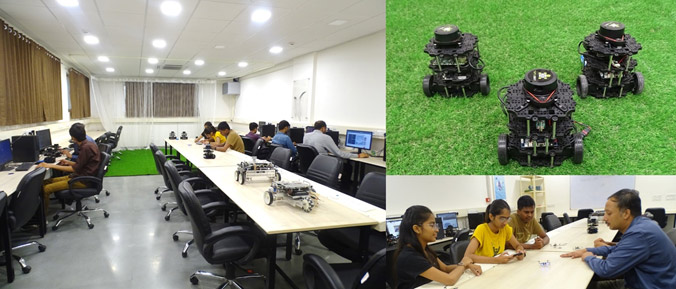
The institute has a state-of-the-art lab facility for teaching, experiments and research in RAS. The lab is equipped with
- Wheeled Mobile Robots
- Unmanned Aerial Vehicles
- Robotic Manipulators
- Sensors and Actuators
- Advanced Microcontrollers
Number of seats
Total number of seats for Minor in RAS limited to 30.
Policies, Procedures and Guidelines
The following rules are applicable only to the RAS Minor
- Students get an option to enrol in the RAS minor at the beginning of Semester 4.
- A maximum of 30 students will be allowed to enroll for the minor. In case more than 30 applications are received, selection will be done based on the Cumulative Performance Index(CPI).
- Students may choose to drop out of the minor in any semester. Once the student drops out, he/she cannot re-enroll for the minor.
- Lateral entry to the minor is not allowed. An option to enroll for the minor (RAS) will be available in Semester 4 only. However, the minor core courses and minor elective courses will be open for all students under the Technical Elective category.
- A student must obtain passing grades in the five designated honours (three core and two electives) courses for the minor to graduate with the BTech (Hons.) in ICT with a Minor in Robotics and Autonomous Systems degree.
- One of the electives in the RAS Minor can be a project – henceforth referred to as Minor Mini Project (MMP). This needs to be approved by the minor’s coordinator in consultation with the UG convener. The project has to be strictly in the area of Robotics, Autonomous systems, Cyber physical systems, Robotic vision, and Machine vision.
- Pertaining to B.Tech Project, there is no restriction on the area of work for the students enrolled in the minor (RAS). A student can choose a topic within the interest of the RAS group or any other area from the ICT domain.
Additional Graduation Requirement – BTech (Honours) in ICT with a Minor in Robotics and Autonomous Systems.
- Minimum number of RAS courses: 5 (Core: 3 and Electives: 2)
- Minimum RAS course credits: 15
- Minimum CPI: 6.5
RAS Course Sequence
- Introduction to Robotics (3-0-2-4) – Semester 4 - RAS Core
- Introduction to Autonomous Systems (3-0-2-4) – Semester 5 – RAS Core
- Robot Programming (1-0-2-3) – Semester 6 – RAS Core
- RAS Elective 1 (3-0-0/2-3/4) – Semester 5/6 – RAS Elective
- RAS Elective 2 (3-0-0/2-3/4) – Semester 6/7 – RAS Elective.
- The Minor electives can be done in any two Semesters from Semester 5, 6, and 7.
- The elective courses basket for the minor electives will be notified to the students of semesters 5, 6 and 7 (at the start of the respective semester) by the minor’s coordinator in consultation with the UG convener and the RAS group.
- A student can opt for a Minor-Mini-Project(MMP), as RAS Elective 1 or 2. MMP will be of 3 credits(0-0-6-3). A student can do at most one MMP.
RAS Core Course Content
Introduction to Robotics
Course Overview, History of Robotics, Robot Arm, Kinematic Structure of Human Arm and Humanoid Robot; Coordinate Frames, Rotation Matrix, Translations, Euler Angles, Quaternion; Homogeneous Transform, Compound Transformations, Jacobians, Denavit-Hartenberg (D-H) Parameters; Inverse Kinematics, Inverse Kinematics for Position/Orientation/ Velocities, Redundancy, Singularities; Equation of Motion, Euler-Lagrange Formulation, Newton-Euler Formulation; Sensors, Actuators, Control Overview, Joint Space Control, Trajectory Generation.
References:
- Saeed B. Niku, Introduction to Robotics: Analysis, Control, Applications, (2nd ed.), John Wiley & Sons Inc., 2010, ISBN: 978-0-470-60446-5
- John Craig, Introduction to Robotics, Mechanics and Control (3 ed.), Prentice Hall, 2003. ISBN 978-0201543612
Introduction to Autonomous Systems
Understanding of dynamic of robot manipulators, mobile robots, and drones (quadrotors), controls for robotic systems for motion-planning, collision avoidance, trajectory optimization, grasping and manipulating objects. Simulation and experiments related to dynamics, trajectory generation, motion planning, and control of autonomous systems, such as robots, manipulators and drones.
References:
- Illah R. Nourbaksh and Roland Siegwart, Introduction to Autonomous Mobile Robots, The MIT Press, First Edition, 2004.
- Steven M. Lavalle, Planning Algorithms, Cambridge University Press, First Edition, 2006.
- Mark W. Spong, Seth Hutchinson, and M. Vidyasagar, Robot Dynamics and Control, John Wiley & Sons, Inc., Second edition, 2004.
Robot Programming
This course introduces students to the Robot Operating System (ROS) as well as to many of the available tools commonly used in robotics. Course focus on theory and hands-on, whereas hands-on will focus on applications and implementations. Students learn how to create software and simulations, interface to sensors and actuators, and integrate control algorithms. The course works through exercises involving a number of autonomous robots (i.e., ground) that students could eventually use in their future robotics research.
References:
YoonSeok Pyo, HanCheol Cho, RyuWoon Jung, and TaeHoon Lim, Robot Programming (1st eds), ROBOTIS Co., Ltd. 2017, ISBN 979-11-962307-1-5