
| Award | Duration | Study Mode |
|---|---|---|
| BS-MS Dual Degree in Data Science and Artificial Intelligence |
3 Years: Bachelor of Science (B.Sc.) 4 Years: Bachelor of Science Honours (B.S.) 5 Years: Master of Science (M.S) or M.S. by Research |
Full Time |
| Intake | Selection Process | Program Starts |
|---|---|---|
| 120 | Multiple Channels | Yearly in July/ August |
- displayNone About the Program
- displayNone Structure and Exit Options
- displayNone Curriculum Details
- displayNone Career Outcomes
- displayNone Entry Requirements
- displayNone Fees & Scholarships
- displayNone FAQs

Artificial Intelligence and data-driven systems are transforming every sector — healthcare, finance, climate science, manufacturing, governance, and digital platforms.
Organisations today need professionals who not only understand algorithms but can design, deploy, and manage responsible AI systems at scale.
Many existing undergraduate programs focus either on traditional computer science or introductory analytics. Few offer an integrated pathway that brings together:
- Rigorous Modelling & Systems Thinking — Strong mathematical foundations combined with scalable, production-ready AI systems.
- Advanced & Trustworthy AI — Modern machine learning, generative and autonomous systems, built with interpretability and responsibility at the core.
- Real-World & Multi-Domain Application — Hands-on problem solving across finance, energy, healthcare, climate, and public policy.
- Flexible, Immersive Learning — Multi-exit options, industry internships, applied projects, and research-driven capstones.
This five-year integrated program is designed to bridge the gap between theory and deployment, innovation and responsibility, and analytics and intelligent system design.
Data Science vs. Artificial Intelligence
Data Science focuses on analysing data, uncovering patterns, and enabling informed decision-making.
Artificial Intelligence (AI) focuses on building systems that can learn, adapt, reason, and make decisions autonomously.
This program integrates both, preparing students to move from data understanding to intelligent system creation.
This program is designed for students who:
- Have a strong interest in mathematics, statistics, and computing, and want to understand the science behind intelligent systems — not just how to use them.
- Seek depth as well as application, combining rigorous analytical training with hands-on system design and deployment.
- Aspire to build next-generation AI systems, including advanced machine learning, autonomous models, and scalable data platforms.
- Are motivated by research, innovation, and real-world problem solving across domains such as finance, healthcare, energy, climate, and public policy.
- Prefer a seamless five-year academic pathway, progressing from strong foundations to advanced specialization and thesis-level work within a single integrated program.
The program is ideal for students who aim to develop both intellectual depth and practical capability, preparing them for impactful careers in advanced data science and artificial intelligence.
The BS–MS Dual Degree in Data Science & Artificial Intelligence is a comprehensive five-year program that builds expertise across the full spectrum of data-driven intelligence: from foundational mathematics to advanced autonomous AI systems.
Progressive Learning Path
The program follows a carefully structured year-wise progression that advances students from foundational understanding to independent innovation:
Year 1 – Foundations
Core grounding in programming, mathematics, and introductory data science. Emphasis on understanding and applying fundamental concepts.
Year 2 – Analytical Depth
Systems-oriented computing and statistical modeling. Students learn to analyze computational and probabilistic methods with greater rigor.
Year 3 – Applied Machine Learning & AI
Machine learning, big data systems, and applied AI. Focus on integrating and evaluating models in practical, real-world settings.
Year 4 – Advanced AI & Deployment
Specialized AI architectures, scalable deployment frameworks, and domain-centric applications. Students begin designing complex AI solutions.
Year 5 – Research, Innovation & Industry Immersion
Thesis or industry internship. Emphasis on independent problem formulation, solution design, evaluation, and development at the highest level of intellectual engagement.
This progression ensures steady development from technical competence to critical thinking, innovation, and leadership in Data Science and Artificial Intelligence.
Beyond Technical Training
Technology does not exist in isolation. The program integrates courses in:
- Humanities and Social Sciences
- Economics of Data and AI
- Product Management
- Entrepreneurship and Technological Innovation
Students learn not only how to build AI systems, but how to deploy them responsibly and sustainably in real-world environments.
Experiential and Applied Learning
Graduates are shaped through:
- Industry internships
- Applied laboratory projects
- Interdisciplinary problem-solving
- Research-focused capstone thesis
Students gain hands-on experience in designing, evaluating, and deploying production-grade AI systems that are explainable, scalable, and human-centered.
The program follows a multi-exit framework aligned with the National Education Policy (NEP 2020), providing academic flexibility and lifelong learning opportunities:
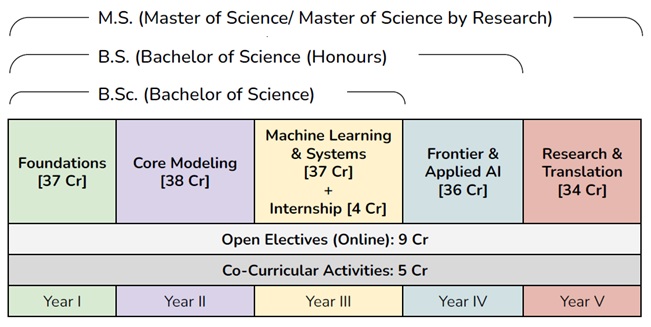
- After 3 Years – B.Sc. (Bachelor of Science)
Strong grounding in programming, statistics, data science, and core machine learning. - After 4 Years – BS (Bachelor of Science – Honours)
Advanced specialization in data engineering, AI systems, and applied analytics. - After 5 Years – MS (Master of Science / Master of Science by Research)
Expertise in autonomous and trustworthy AI, completed through a research thesis or industry-focused internship.
This multi-exit framework ensures flexibility while maintaining academic rigor, allowing students to align their educational journey with career goals, entrepreneurial ambitions, or higher studies.
Program Credit Framework
The BS–MS Dual Degree in Data Science & Artificial Intelligence is a 200-credit, five-year program designed to balance theoretical depth, practical capability, and experiential learning.
Core Curriculum Distribution – 110 Credits (55%)
The core curriculum ensures strong scientific and engineering foundations:
- Computing – 17.5%
Programming, data structures, algorithms, systems, and scalable computing. - Data Science & AI – 16%
Statistical modeling, machine learning, deep learning, and AI systems. - Mathematics – 14%
Linear algebra, calculus, probability, optimization, and analytical methods. - Humanities & Social Sciences – 7.5%
Ethics, economics, policy, communication, and responsible technology.
This balanced structure ensures graduates are technically strong and contextually aware.
Elective & Applied Components – 90 Credits (45%)
Students progressively tailor their academic pathway through:
- Program Electives – 15.5%
Advanced AI, data engineering, autonomous systems, and domain-specific analytics. - Open Electives – 4.5%
Courses from other disciplines to broaden intellectual exposure. - Online Open Electives – 4.5%
Curated external courses aligned with emerging technologies. - Projects, Seminars & Internships – 18%
Industry immersion, research engagement, and applied AI system design. - Co-Curricular Activities – 2.5%
Innovation labs, technical competitions, student clubs, and professional development.
This structure supports both specialization and interdisciplinary exploration.
Program Elective Basket Structure
To reflect the interdisciplinary and evolving nature of Data Science and Artificial Intelligence, elective courses are organized into four thematic baskets. This structure enables flexible specialization while ensuring balanced exposure to theory, systems, applications, and responsible innovation.
- Modeling in AI & Machine Learning
Advanced mathematical, statistical, and algorithmic foundations for designing intelligent models and learning systems. - Systems & Engineering for AI
Scalable, reliable, and production-ready AI system design, deployment, and infrastructure. - Domains & Applied Analytics
Application of data science and AI techniques to real-world sectoral challenges. - Ethics, Governance & Emerging AI
Responsible AI, policy, interpretability, and emerging trends in trustworthy intelligent systems.
This elective basket framework supports individualized learning pathways while maintaining alignment with the program’s broader objectives. It ensures that graduates develop technical mastery alongside contextual awareness and ethical responsibility.
- The program elective courses under all the baskets are indicative and may be revised based on faculty expertise and resource availability.
- Students must select courses from two different domains listed under the "Domains & Applied Analytics" category.
Semester-wise Courses
| Semester | Course Category | Course Title | Credits (L-T-P) |
| Sem 1 | Program Core (Maths) | Calculus | 4 (3-1-0) |
| Sem 1 | Program Core (Maths) | Linear Algebra | 4 (3-1-0) |
| Sem 1 | Program Core (Computing) | Computational Thinking & Problem Solving | 3 (3-0-0) |
| Sem 1 | Program Core (Computing) |
Programming in Python |
4 (3-0-2) |
| Sem 1 | Program Core (HSS) | Language and Communication | 3 (3-0-0) |
| 18 (15-2-2) | |||
| Sem 2 | Program Core (Maths) | Discrete Mathematics | 4 (3-1-0) |
| Sem 2 | Program Core (Maths) | Probability and Statistics | 4 (3-1-0) |
| Sem 2 | Program Core (Computing) | Data Structures using Python | 4 (3-0-2) |
| Sem 2 | Program Core (DS) | Interactive Data Visualization | 4 (3-0-2) |
| Sem 2 |
Program Core (HSS) |
The Art of Telling | 3 (3-0-0) |
|
|
19 (15-2-4) | ||
| Semester | Course Category | Course Title | Credits (L-T-P) |
| Sem 3 | Program Core (Maths) | Statistical Methods | 4 (3-1-0) |
| Sem 3 | Program Core (Maths) | Linear and Integer Programming | 4 (3-1-0) |
| Sem 3 | Program Core (Computing) | Design & Analysis of Algorithms | 4 (3-0-2) |
| Sem 3 | Program Core (Computing) | Principles of Computer Systems | 4 (3-0-2) |
| Sem 3 | Program Core (HSS) | Environmental Studies | 3 (3-0-0) |
| 19 (15-2-4) | |||
| Sem 4 | Program Core (Maths) | Nonlinear Optimization and Heuristics | 4 (3-1-0) |
| Sem 4 | Program Core (Computing) | Database Management Systems | 4 (3-0-2) |
| Sem 4 | Program Core (Computing) | Cloud Computing Foundations | 4 (3-0-2) |
| Sem 4 | Program Core (Computing) | Software Engineering | 4 (3-0-2) |
| Sem 4 | Program Core (HSS) | Principles of Economics | 3 (3-0-0) |
| 19 (15-1-6) | |||
| Semester | Course Category | Course Title | Credits (L-T-P) |
| Sem 5 | Program Core (Computing) | Web Services and API Design | 4 (3-0-2) |
| Sem 5 | Program Core (DS) | Big Data Processing & Management | 4 (3-0-2) |
| Sem 5 | Program Core (DS) | Fundamentals of Machine Learning | 4 (3-0-2) |
|
Sem 5 |
Program Elective 1 | Modeling in AI/ML | 4 (3-0-2) |
| - Time Series Forecasting - Artificial Intelligence Foundations |
|||
| Systems & Engineering for AI | |||
| - Advanced Databases (NoSQL, VDBs) - Distributed Databases |
|||
| Sem 5 | Program Core (HSS) | Ethics in Data and AI | 3 (3-0-0) |
| 19 (15-0-8) | |||
| Sem 6 | Program Core (DS) | Deep Learning | 4 (3-0-2) |
| Sem 6 | Program Core (DS) | Machine Learning Operations | 4 (3-0-2) |
|
Sem 6 |
Program Elective 2 | Modeling in AI/ML | 4 (3-0-2) |
| - Digital Image Processing - Classical NLP - Speech & Audio Processing - Information Retrieval |
|||
|
Sem 6 |
Program Elective 3 | Systems & Engineering for AI | 4 (3-0-2) |
| - Parallel and Distributed Systems - Cybersecurity and Ethical Hacking - Knowledge Graphs - High Performance Computing |
|||
| Sem 6 | Applied Project | B.Sc. Exit / Applied Project | 2 (0-0-4) |
|
|
18 (12-0-12) | ||
| Summer Internship | 4 (0-0-8) | ||
| Semester | Course Category | Course Title | Credits (L-T-P) |
| Sem 7 | Program Core (DS) | Reinforcement Learning | 4 (3-0-2) |
| Sem 7 | Program Elective 4 | Modeling in AI/ML | 4 (3-0-2) |
| - Neural Natural Language Processing - Computer Vision - Neural Speech Processing - Recommendation Systems - Spatiotemporal Data Analysis |
|||
| Sem 7 | Program Elective 5 | Domain & Applied Analytics | 4 (3-0-2) |
| - Manufacturing & Industrial Systems Analytics - Finance & Econometrics - Environment, Energy, and Sustainability Analytics - Cybersecurity Analytics |
|||
| Sem 7 | Open Elective 1 | - Data and Culture - Indian Knowledge System - or any other 3 Credit Course |
3 (3-0-0) |
| Sem 7 | Project 1 (Phase I) | Project 1 (Phase I) | 3 (0-0-6) |
| 18 (12-0-12) | |||
| Sem 8 | Program Core (DS) | Deep Generative Models | 4 (3-0-2) |
| Sem 8 |
Program Elective 6 |
Modeling in AI/ML | 4 (3-0-2) |
| - Multimodal Learning and Reasoning - Graph Representation Learning - Causal Inference and Reasoning - Advanced Topics in Machine Learning |
|||
| Systems & Engineering for AI | |||
| - Federated Machine Learning - Adversarial Machine Learning - AI Systems: Thinking beyond Models |
|||
| Sem 8 | Program Elective 7 | Domain & Applied Analytics | 4 (3-0-2) |
| - Business Process and Automation Analytics - Marketing & Consumer Analytics - Healthcare Analytics - Agri Analytics |
|||
| Sem 8 | Open Elective 2 | - Technology Entrepreneurship and Innovation - Innovation Management and Design Thinking - Organizational Economics - or any other 3 credit course... |
3 (3-0-0) |
| Sem 8 | Project 1 (Phase II) | Project 1 (Phase II) | 3 (0-0-6) |
| Grand Innovation Showcase (GIS): Showcase of Project 1 through a demonstration or poster to communicate the innovation to the general public | 18 (12-0-12) | ||
| Semester | Course Category | Course Title | Credits (L-T-P) |
| Sem 9 | Program Core (DS) | AI Systems Engineering | 4 (3-0-2) |
| Sem 9 | Program Elective 8 | Ethics, Governance & Emerging AI | 3 (3-0-0) |
| - AI Governance, Policy, and Regulation - Trustworthy and Reliable Machine Learning - Fairness, Accountability, Transparency in AI Systems |
|||
| Sem 9 | Open Elective 3 | - Startup Strategy and Growth Management - Managing Technology and Product Innovation - Business Law and Entrepreneurship - or any other 3 credit course... |
3 (3-0-0) |
| Sem 9 | Capstone Seminar / Thesis | Industrial Research Case Studies in AI/ DS | 2 (2-0-0) |
| Sem 9 | Project 2 / Thesis | Project 2/ Thesis | 4 (0-0-8) |
| 16 (11-0-10) | |||
| Sem 10 | Internship/ Thesis | Industry Internship/ Thesis | 18 (0-0-36) |
| Co-Curricular Activities (5 Cr --> 75 Hrs.) | 5 Cr | ||
| Students must complete three online open electives (9 Cr). They are required to earn at least one such course (3 Cr) within the first three years and at least two (6 Cr) within the first four years. Each course is expected to include a minimum of 24 hours of instruction. | 3x 3(3-0-0) = 9 | ||
| Total Program Credits | 200 Credits | ||
The BS–MS Dual Degree in Data Science & Artificial Intelligence prepares graduates for high-impact careers across industry, research, entrepreneurship, and public policy. With strong foundations in mathematics, computing, AI systems, and responsible technology, students graduate with both analytical depth and the capability to deploy in the real world.
Industry & Corporate Sector
Graduates contribute to intelligent system design and data-driven innovation across sectors such as: Technology & Digital Platforms, Finance & FinTech, Healthcare & Bioinformatics, Energy & Sustainability, Manufacturing & Smart Systems.
Typical Roles Include:
- Data Scientist
- Machine Learning Engineer
- AI Engineer
- Data & Cloud Architect
- Business Intelligence Analyst
- AI / Analytics Product Manager
Research & Higher Studies
The program provides strong preparation for advanced research pathways. Graduates may:
- Pursue Ph.D. programs in Machine Learning, Explainable AI, Computational Sciences, or Human-Centered AI
- Join applied research laboratories and innovation centers
- Contribute to R&D divisions working on next-generation AI systems
The integrated five-year structure ensures readiness for research-intensive environments globally.
Entrepreneurship & Innovation
With exposure to product thinking, innovation management, and AI-driven business models, graduates may:
- Found AI and analytics startups
- Build scalable AI-based products and platforms
- Launch consulting ventures focused on data strategy and AI deployment
- Lead technology-driven innovation initiatives
The program encourages responsible and sustainable technology entrepreneurship.
Governance, Policy & Social Impact
Graduates are equipped to contribute to digital governance and evidence-based policy frameworks.
Potential roles include:
- Data Policy Analyst
- AI Strategy Consultant
- Smart Infrastructure Specialist
- Technology Policy Advisor
Opportunities exist within public agencies, think tanks, multilateral organizations, and institutions shaping global AI governance.
Education & Professional Consulting
With its interdisciplinary and research-oriented foundation, the program also prepares graduates for:
- Academic and teaching roles
- Professional training in data science and AI
- Strategic consulting for AI adoption and digital transformation
Graduates can bridge the gap between emerging technologies and their implementation in organisations.
The Institute reserves the right to modify procedural aspects, cut-offs, and seat allocation ceilings prior to commencement of the admission cycle, in compliance with applicable regulatory norms.
1. Eligibility Criteria
- The candidate must have completed (or be appearing in) Class XII (or equivalent) with Mathematics as a compulsory subject with a minimum aggregate of 60% or its equivalent.
- All admissions are provisional until documents are successfully verified.
2. Seat Allocation Framework
Admissions shall be conducted through the following channels. The percentages indicated represent maximum ceilings. The actual number of seats filled under a channel may vary depending on the applicant pool and merit.
2.1 DAU Entrance Test — Maximum 30% of Approved Intake
- Admission based on performance in the Institute’s Entrance Test.
- Merit list prepared based on normalised test scores.
- Cut-offs shall be determined annually by the Admission Committee.
2.2 National-Level Entrance Examinations — Maximum 60% of Approved Intake
Admission based on the Mathematics percentile obtained in:
- Joint Entrance Examination – Main (JEE Main), or
- Common University Entrance Test (CUET).
Detailed business rules governing this channel are provided in Appendix A.
2.3 Direct Admission Category — Maximum 5% of Approved Intake
Eligible candidates may be considered under this category if they satisfy any one of the following criteria. The total number of seats is divided equally between the two sub-channels under this category. However, the institute reserves the right to fill any unfilled seat with any other channel or sub-channel.
(A) Exceptional Board Performance
- ≥ 99.5 percentile (or equivalent as determined by the Institute) in the qualifying Board examination.
(B) Recognised Olympiad Achievements (within the last four years)
- Qualified for IMOTC / EGMOTC, or
- Qualified for IOITC, or
- Awarded Gold or Silver Medal at the Indian National Olympiad in Informatics (INOI).
All claims must be supported by verifiable documentary proof. The Admission Committee reserves the right to validate credentials.
2.4 International / NRI Category — Maximum 5% of Approved Intake
International and NRI candidates may apply based on:
- SAT or ACT scores, or
- JEE Main Mathematics percentile.
Unfilled seats under this category may be converted to domestic seats.
3. Inter-Category Reallocation and Additional Evaluation
The percentage allocations specified under each admission channel represent the maximum permissible intake and do not guarantee that all such seats shall be filled.
The Institute reserves the right to:
- Fill fewer seats in any admission category or sub-category.
- Reallocate unfilled seats across categories or sub-categories based on merit, seat availability, and institutional requirements.
- Conduct an interview or additional evaluation process for shortlisted candidates if seats remain unfilled after the initial merit-based rounds.
Where an interview or additional evaluation is conducted:
- Candidates may be shortlisted based on merit from among those who were not offered admission in earlier rounds.
- Interview performance may serve as a qualifying criterion and/or as a tie-breaking mechanism.
- The evaluation process and criteria shall be determined and approved by the Admission Committee prior to implementation.
Notwithstanding the above, the Institute reserves the right to leave any seat vacant if suitable candidates are not available or if filling such seats is not deemed appropriate by the Admission Committee.
Appendix A
This Appendix specifies the business rules applicable to admissions under the National-Level Entrance Examinations Channel for the Academic Year 2026–27.
A1. Eligible National Examinations
Admission under this channel shall be based on performance in one or more of the following:
- Joint Entrance Examination – Main 2026
- Common University Entrance Test (UG) 2026 (Mathematics and English)
- Joint Entrance Examination – Main 2025
- Common University Entrance Test (UG) 2025 (Mathematics and English)
A2. Application Requirements
- 1. Candidates must provide valid application number(s) for one or more eligible examinations.
- 2. Only scores declared and available on or before 10 July 2026 shall be considered.
- 3. Candidates shall be considered for ranking if:
- At least one valid score is available by the deadline, and
- At least one available score exceeds the prescribed minimum cutoff.
If no valid percentile score is available by the deadline, the candidate shall not be ranked under this channel.
A3. Seat Allocation Principles
Seats shall be allocated considering:
- Position in the Merit List.
- Availability of seats at different admission channels.
- Other approved business rules.
A4. Merit List Preparation
A4.1 Composite Score (Q)
For each candidate: Q = Maximum of available Mathematics percentiles from:
- JEE Main 2026
- CUET (UG) 2026
- JEE Main 2025
- CUET (UG) 2025
If none is available, Q is invalid, and the candidate shall not be ranked.
A4.2 Tie-Breaking Rules
If two or more candidates have identical Q:
First Tie-Breaker (T1)
- If Q corresponds to JEE Main 2026 Mathematics percentile →
T1 = JEE Main 2026 Total Percentile. - If Q corresponds to CUET (UG) 2026 Mathematics percentile →
T1 = CUET (UG) 2026 English Percentile. - If Q corresponds to JEE Main 2025 Mathematics percentile →
T1 = JEE Main 2025 Total Percentile. - If Q corresponds to CUET (UG) 2025 Mathematics percentile →
T1 = CUET (UG) 2025 English Percentile.
Higher T1 ranks higher.
Second Tie-Breaker (T2)
If Q and T1 are identical:
- T2 = Age in days as on 31 May 2026.
- Lower T2 (younger candidate) ranks higher.
A5. Final Ranking Order
Candidates shall be ranked in descending order of:
- Q
- T1
- T2
A6. Cut-Offs and Validity
- Minimum qualifying percentile shall be determined by the Admission Committee.
- Meeting the cutoff does not guarantee admission.
- Official scorecards shall prevail in case of discrepancy.
The Institute reserves the right to interpret and apply these rules in case of ambiguity. Decisions of the Admission Committee shall be final and binding.
For Domestic Students
At the time of counselling, an amount of Rs. 1,75,000 (Rs. 1,50,000/- towards Tuition Fee for the First Semester and Rs. 25,000/- towards a Caution Deposit) - The registration fee is payable at the time of registration and hostel rent on allotment of the hostel room.
| Tuition fee | Rs. 3,00,000/- per annum (i.e., Rs. 1,50,000/- per semester). |
| Registration Fee | Rs. 2,500 per Semester (including summer semester) |
| Caution Deposit | Rs. 25,000 (Refundable at the end of the program) |
| Hostel Rent (including Food and Transportation) For Off Campus Hostel within short distance |
Rs. 2,00,000/- per year for double occupancy Rs. 1,60,000/- per year for triple occupancy One-time Rs. 15,000/ refundable security deposit, |
- Subject to revision every Academic Year from 8 to 10%.
For International / NRI Students
At the time of counselling, an amount of USD 7,000 (USD 6,000/- towards Tuition Fee for the First Semester and USD 1,000/- towards a Caution Deposit) - The registration fee is payable at the time of registration and hostel rent on allotment of the hostel room.
| Tuition fee | USD 12,000/- per annum (i.e., USD 6,000/- per semester). |
| Registration Fee | USD 100 per Semester (including summer semester) |
| Caution Deposit | USD 1,000 (Refundable at the end of the program) |
| Hostel Rent (including Food and Transportation) For Off Campus Hostel within short distance |
Rs. 2,00,000/- per year for double occupancy Rs. 1,60,000/- per year for triple occupancy One-time Rs. 15,000/ refundable security deposit, |
- Subject to revision every Academic Year from 8 to 10%.
Education Loan
The Institute will facilitate students in availing educational loans from selected Banks. Bank officials will be on campus at the time of registration for admitted students to provide details on the loan procedures and terms and conditions. The students can also avail a loan from banks of their choice, and in either case, the Institute will extend support in completing the loan documentation process.
Refund Policy
The refund policy for the withdrawing candidates will be in accordance with the UGC rules.
Scholarships / Fellowships
The Institute provides financial support in the form of scholarships to eligible students. More details of it can be seen here.
BS-MS Scholarships at DAU | BS-MS Institute Fellowships at DAU
UG/PG Cybage Khushboo Scholarships | Scholarships Offered to Students
1. What is a BS–MS dual degree program?
A BS–MS dual degree program is an integrated five-year academic pathway that combines undergraduate and postgraduate study in a single structured curriculum. Students progress from foundational coursework to advanced specialisation and graduate-level study without needing to apply separately for a master’s degree.
2. How is a dual degree different from a traditional B.Tech. or B.Sc. program?
Dual degree programs are designed to provide deeper academic specialisation and advanced training. Students move beyond undergraduate foundations to graduate-level courses, research, and industry projects within the same program, preparing them for leadership roles in technology, research, and innovation.
3. What degrees are awarded upon completion?
Students receive both a Bachelor of Science – Honours (BS) degree and a Master of Science (MS) degree upon successful completion of the five-year program.
4. Are there exit options during the program?
Yes. In line with the National Education Policy (NEP 2020), the program offers structured exit options:
- After 3 years – Bachelor of Science (B.Sc.)
- After 4 years – Bachelor of Science - Honours (BS)
- After 5 years – Master of Science (MS)
These exits provide flexibility while maintaining academic rigour.
5. What is the duration of the program?
The program is five years (ten semesters) and follows a progressive learning structure that moves from foundational concepts to advanced specialisation and research or industry engagement.
6. What kind of courses will students study?
Students study a balanced curriculum that includes:
- Mathematics and statistics
- Computing and programming
- Data science and artificial intelligence
- Systems and engineering concepts
- Domain applications
- Ethics, governance, and social impact of technology
The program also includes electives, projects, internships, and research opportunities.
7. Are internships and projects part of the program?
Yes. The curriculum includes industry internships, applied projects, seminars, and research-based capstone work, allowing students to gain hands-on experience and industry exposure.
8. What career opportunities are available after completing the program?
Graduates can pursue careers across multiple sectors, including technology, finance, healthcare, energy, digital services, and research organisations. Typical roles include:
- Data Scientist
- Machine Learning Engineer
- AI Engineer
- Data Architect
- Analytics Consultant
- AI Product Manager
Graduates may also pursue Ph.D. programs, research careers, or entrepreneurship.
9. Can students pursue higher studies after completing the program?
Yes. The integrated M.S. degree provides strong preparation for Ph.D. programs and advanced research opportunities at leading universities and research institutions worldwide.
10. Is the program suitable for students interested in research?
Yes. The curriculum emphasises analytical foundations, advanced AI techniques, and research-driven projects. Students can pursue thesis-based research in their final year.
11. Does the university support entrepreneurship?
Yes. Students interested in startups and innovation can access entrepreneurship programs, mentorship, and incubation support through the university’s incubation ecosystem.
12. What facilities support learning and innovation?
Students have access to modern laboratories, computing infrastructure, collaborative learning spaces, and research centres that support advanced work in data science, computing, and AI.
13. What support systems are available for students?
Students benefit from:
- Academic mentoring and advising
- Research supervision and labs
- Career services and internship support
- Innovation and entrepreneurship initiatives
- Access to interdisciplinary learning opportunities
14. What kind of campus activities can students participate in?
Students can participate in technical clubs, hackathons, research groups, innovation challenges, cultural events, and sports, contributing to a vibrant campus experience.
15. When does the application process begin?
The application process typically begins in March each academic year, with the program commencing in July/August. Applicants are encouraged to check the official admissions page regularly for updated timelines.
16. Is mathematics required in Class XII?
Yes. Since the program involves advanced topics in data science, computing, and artificial intelligence, a strong background in mathematics is essential.
17. Are scholarships or financial assistance available?
Yes. The university offers scholarships and financial assistance to eligible students based on academic merit and other criteria. Details are available on the Fee & Scholarships page.
18. Can international students apply?
Yes. International applicants are welcome to apply, provided they meet the university’s academic and admission requirements.
19. How can applicants track their application status?
Applicants can monitor the progress of their application through the online admissions portal of Dhirubhai Ambani University.
20. How can students apply to the program?
Applications can be submitted through the online admission portal of Dhirubhai Ambani University. Detailed eligibility criteria, admission processes, and timelines are available on the program admission page.