
B.Tech. and BS-MS 2026 admissions closed
View Application - Admission Status
- Important Dates
- Intake
- Program Structures and Brochures
- Placement Statistics
- Eligibility Criteria
- Selection Criteria
- Fee Structure
- Scholarships
- How to Apply
- FAQs
- For Inquiries
- Important Notes
| Filling of online Application Forms commences on | 24 March 2026 |
| On-line application closes on (Closed) | 22 June 2026 |
| Announcement of Merit List for FIRST round | 02 July 2026 |
| Fees payment window for shortlisted candidates in FIRST round | 02 – 08 July 2026 |
| Announcement of Admission Status for FIRST round | 10 / 13 July 2026 |
| Registration and document verification at DAU campus for confirmed candidates | 01 August 2026 |
| Orientation Program | 03-07 August 2026 |
| Commencement of Classes | 10 August 2026 |
Number of seats: 312
- B.Tech. Information and Communication Technology (ICT) – 72
- B.Tech. (Honours) in ICT with minor in Computational Science – 54
- B.Tech. Mathematics and Computing – 54
- B.Tech. Electronics and VLSI Design – 24
- B.Tech. Computer Science and Artificial Intelligence – 72
- B.Tech. Electronics and Communication Engineering – Artificial Intelligence – 36
B.Tech. Information and Communication Technology (ICT)
Information & Communication Technology (ICT) embodies the convergence of Computer and Communication systems and has obtained wide acceptance as a distinct discipline. ICT is considered to be a discipline dealing with accessing, storage, processing, transmission, reception and display of information, primarily using digital systems and techniques. The curriculum in the B.Tech. (ICT) program tries to address the optimized convergence of existing Computer Science and Engineering (CSE) as well as Electronics and Communication Engineering (ECE) disciplines by identifying the broad areas of performance capabilities. It is also expected that B.Tech. (ICT) graduates would enjoy a special niche only if they have certain performance capabilities not found in conventional CSE and/or ECE graduates. For details of the program click here.
Program Brochure
DownloadB.Tech. (Honours) in ICT with minor in Computational Science
Computational Science is concerned with constructing mathematical models, simulating and quantitative analysis techniques, and using computers to analyze and solve scientific problems with applications in engineering and social sciences. In Computational Science, unlike the traditional theoretical and experimental approaches, scientists and engineers gain understanding mainly through the analysis of mathematical models implemented on computers. Typically, these models require massive amounts of calculations and are often executed on high performance computing backbone consisting of supercomputers or distributed computing or several inter-connected clusters of workstations and personal computers. The curriculum in B.Tech. (Honours) in ICT with minor in Computational Science aims to provide expertise to the students in techniques involved in modelling and simulation of complex and large scale systems, implementation on computers through parallel and high performance computing techniques and finally analysis and visualization of these large scale data sets. Further details of the program are available here.
To complete the B.Tech. (Honours) in ICT with minor in Computational Science Program successfully, the students have to take additional 18-24 credits worth of courses besides the usual ICT courses. The student must obtain a minimum CPI of 6.5 after completion of third Semester to continue in the program failing which she/he will be moved to the B.Tech. (ICT) Program. The students who have obtained a CPI of 7.5 and above may apply at the end of the third Semester for transfer to the B.Tech. (Computational Science) Program and the transfer will be granted only subject to availability of seats and in descending order from the highest CPI obtained.
Program Brochure
DownloadB. Tech. Mathematics and Computing (MnC)
Mathematics and Computing (MnC) is a fusion of Mathematics and Computer Science that has obtained wide acceptance as a distinct discipline over the past few years. It arises out of dealing with Mathematics as a fundamental tool in computing and with Computing as a primary component of mathematical problem solving. The program has been specially designed to meet the increasing needs of professionals who would be able to respond to the convergence between mathematical and computational problem solving.
The program aims at expanding the mathematical, algorithmic and computational thinking of students and at providing sufficient and solid foundation for skill development in MnC. A strong mathematical foundation would enable the study and analysis of abstract concepts and to model many real life problems mathematically, algorithmic thinking would provide ways to solve these mathematical problems in an automated way and computational thinking would allow for evaluating the efficiency of these solutions. The program aims to provide exposure to the students who wish to build a professional career in MnC, working at the cutting edge of technology, research and development. On successful completion of the program, the students would have acquired essential theoretical, technical and practical knowledge for solving real-world problems, and will have the ability to demonstrate excellent analytical, logical and problem solving skills. The students would have also acquired social and ethical attributes that would enable them in applying their skills for societal needs with effective communication both orally and in writing. For details of the program click here
Program Brochure
DownloadB. Tech. Electronics and VLSI Design (EVD)
Semiconductor integrated circuits (ICs) are the backbone of the current revolution in electronics and computing. The Indian government has recently launched India Semiconductor Mission with a vision to enable India's emergence as a global hub in electronics manufacturing and design. Given the increasing interest of the nation in semiconductor manufacturing and R&D, the sector is likely to witness a spike in demand for engineers with semiconductor know-how. The objective of the B.Tech. in Electronics and VLSI Design (EVD) is to create industry ready undergraduate manpower for the semiconductor industry.
The focus of the Electronics and VLSI Design program is to impart state-of-the-art knowledge of advancing semiconductor and VLSI design along with development of embedded processors and high-performance computing systems those are used in modern electronic products. The graduates of this program will be able to design hardware and software, conceptualize, implement circuits and systems, build computing systems along with realization of next generation portable consumer electronics like mobile phones, tabs, bio-medical devices, modern communication systems and gaming devices The students will get exposure and hands-on training on various industry standard electronic design automation (EDA) tools such as Cadence, Synopsys, OrCad, MATLAB, Xilinx etc. and hardware boards viz. FPGA, CPLD, etc. to design integrated circuits. Students will also gain direct industry experience through internships. The rural internship during their course will enable students to appreciate the socio-cultural aspect of the Indian society and motivate to explore electronic based solutions to some prevailing needs of the rural India. The program also includes compulsory summer research internships to be taken up at research organization labs. Electronics and VLSI Design is an interdisciplinary program, allowing students to take various courses ranging from Circuits and Systems, Solid State Devices, VLSI Technology, Embedded Processors, Sensors and Systems, Real Time Operating Systems, IoT, Secure Devices, MEMS along with opportunity to take various discipline and free electives. Currently, there are two pathways offered to the students where he / she can take elective courses leading to specialization in:
- Electronic System Design
- VLSI Design
For more details of the program, click
Program Brochure
DownloadB.Tech. Computer Science and Artificial Intelligence (CS and AI)
DAU’s B.Tech. in Computer Science and Artificial Intelligence (CS and AI) is a four-year undergraduate program designed for students who want strong foundations in Computer Science together with modern Artificial Intelligence. Computing systems now drive innovation across technological sectors, and AI increasingly enables pattern discovery, prediction, and decision-making across domains such as vision, speech, natural language processing, robotics, healthcare, business, and finance.
The CS and AI program therefore combines the theory, design, and application of computing systems with the concepts, tools, and technologies needed to create intelligent systems. The curriculum is designed to prepare students for both research and industry by building mathematical maturity, systems understanding, and AI-oriented problem-solving capability.
For more details of the program, click
Program Brochure
DownloadB.Tech. Electronics and Communication Engineering – Artificial Intelligence (ECE-AI)
The B.Tech in Electronics and Communication Engineering – Artificial Intelligence (ECE-AI) at Dhirubhai Ambani University is designed to address the growing convergence of electronics, communication technologies, and AI. Modern electronic and communication systems increasingly rely on intelligent algorithms to enhance performance, adaptability, and efficiency. From smart devices and IoT platforms to next-generation wireless networks and autonomous systems, AI is transforming how electronic systems are designed, optimized, and operated.
The program provides a strong foundation in core ECE disciplines, including electronic circuits, signals and systems, electromagnetics, communication engineering, and control systems, supported by rigorous training in mathematics, programming, and computing. Building on this foundation, students gain expertise in AI, machine learning, and data-driven techniques, and learn how these methods can be applied to signal processing, wireless communication, embedded systems, and intelligent electronic systems.
The curriculum emphasizes hands-on learning, modern engineering tools, and system-level design. Students develop the ability to design and implement integrated hardware–software–AI solutions, working with tools such as simulation environments, embedded platforms, and AI frameworks. The program also fosters critical thinking, teamwork, and ethical responsibility.
Graduates of the program will be well prepared for careers in the electronics, semiconductor, telecommunications, and AI industries, as well as for advanced study and research in emerging areas at the intersection of ECE and intelligent systems.
For more details of the program, click
Program Brochure
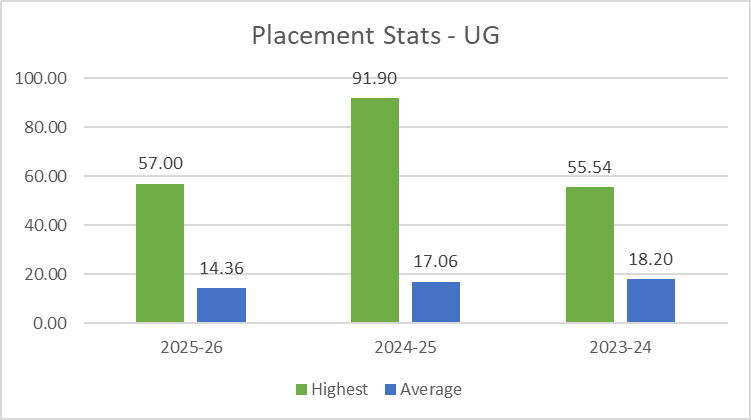
DownloadPlacement Statistics for the Last Three Years - Undergraduate Programs:
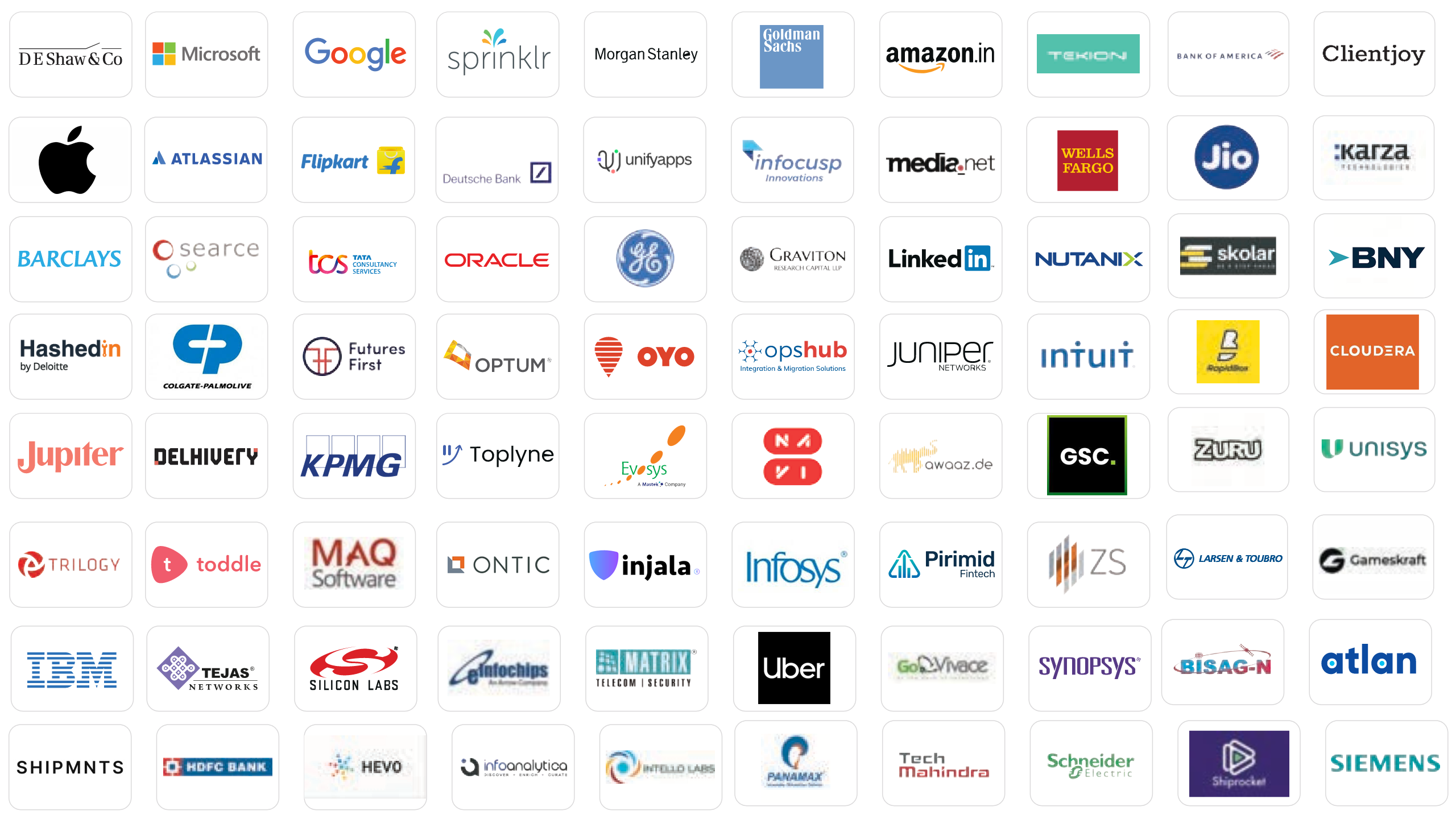
Prominent Recruiters:
Educational qualification
The minimum academic qualification for admission to the programs is that the candidate must have passed with the minimum percentage of marks as prescribed by the AICTE from time to time in final examination of 10+2 (Class XII) or its equivalent referred to as the qualifying examination (mentioned below). The candidate must have passed in final examination of 10+2 (Class XII) or its equivalent with Mathematics, Physics and any one of Chemistry/Bio-technology/Computer Science/Biology. Candidates appearing in the qualifying examination in 2026 are also eligible to apply for consideration of provisional admission. All candidates who are offered provisional admission will be required to produce the proof of having passed the qualifying examination (10+2 examination or equivalent) to the Institute latest by 30 October 2026, failing which the provisional admission will stand, cancelled.
If a candidate is found ineligible at a later date, even after admission to School of Technology, Dhirubhai Ambani University (Formerly DA-IICT), her/his admission will be cancelled. All admissions will be subject to verification of facts from the original testimonials/certificates/documents of the candidates. The decision of the competent authority at DAU (Formerly DA-IICT) regarding eligibility of any candidate shall be final.
A list of qualifying examinations is given below:
- The final examination of the 10+2 system, conducted by any recognized Central/State Board, such as Central Board of Secondary Education, New Delhi; Council for the Indian School Certificate Examinations, New Delhi; etc.
- Intermediate or two-year Pre-University examination conducted by a recognized Board/University.
- Final examination of the two-year course of the Joint Services Wing of the National Defense Academy.
- Senior Secondary School Examination conducted by the National Institute of Open Schooling with a minimum of five subjects.
- Any Public School/Board/University examination in India or in any foreign country recognized as equivalent to the 10+2 system by the Association of Indian Universities (AIU).
- H.S.C. vocational examination.
- A Diploma recognized by AICTE or a State Board of Technical Education of at least 3 years duration
- General Certificate Education (GCE) examination (London/ Cambridge / Sri Lanka) at the Advanced (A) level.
- High School Certificate Examination of the Cambridge University or International Baccalaureate Diploma of the International Baccalaureate Office, Geneva.
- Candidates who have completed the Class 12 (or equivalent) examination outside India or from a Board not specified above should produce a certificate from the Association of Indian Universities (AIU) to the effect that the examination they have passed is equivalent to the Class 12 Examination. If the passing board of the qualifying examination is a foreign board having centre/s in India, approval letter issued to such school/centre by the respective State Government Education Department shall be required along with AIU equivalence certificate.
- In case the Class 12 Examination is not a public examination, the candidate must have passed at least one public (Board or Pre-University) examination earlier.
- Board of Open Schooling and Skill Education (BOSSE), Sikkim. Approval letter issued to such school/centre by the respective State Government Education Department shall be required.
Age
Only those candidates whose date of birth falls on or after 01 October 2001 are eligible. Date of birth as recorded in the 10th or 12th standard certificate, as issued by the Board/University only, will be taken as authentic. Candidates must produce this certificate in original as proof of their age at the time of counselling.
Admission to the B. Tech. programs will be based on the All India Rank of Joint Entrance Examination 2026 (JEE-2026) Main, which is conducted by the National Testing Agency, Government of India. Therefore, candidates who are appearing for JEE 2026 Main can only apply for these programs.
The short-listed candidates will be offered admission (confirmed/waitlisted) in order of their merit (based on the All India Ranking of JEE (Main) 2026).
All India Category candidates belonging to Scheduled Caste and Scheduled Tribe will be admitted on relaxed criteria as compared to the general category candidates. In case some of the reserved seats are not filled in, the unfilled seats will be transferred to the general category.
The DAU (Formerly DA-IICT) reserves the right to change the eligibility, number of seats, admission policy and procedures etc., for All India Category without any prior Notice.
At the time of counselling an amount of Rs.2,17,500 (Rs.1,92,500 towards Tuition Fee for the First Semester and Rs. 25,000 towards Caution Deposit) is to be paid. Subsequently, fees are charged semester-wise, with the registration at the beginning of each semester.
| Tuition fee* | Rs.1,92,500 per Semester |
| Registration Fee | Rs. 2,500 per Semester |
| Caution Deposit | Rs.25,000 (Refundable at the end of the Program) |
| Hostel Rent | Rs. 37,800 per semester |
| Food | On actuals. There are multiple food options available in the campus. (The expense will be approximately Rs. 5,500 per month) |
* This Fee Structure is submitted to the Appellate Committee of the State Government for consideration..
* Subject to revision every Academic Year from 8 to 10%.
For B.Tech. (EVD)
Value Added Course 1 Fee:
A value added course - SHILP (on Device Fabrication and Characterization) with CEERI Pilani is scheduled in Summer Break after the 2nd semester for B.Tech. (EVD) students. The fee for this value added course is Rs. 18,000 and to be paid along with the 2nd semester tuition fee.
Value Added Course 2 Fee:
To support the Digital IC Design and Tape Out in the fourth semester, a value added state-of-the-art Industrial Skill Development Course on VLSI Chip Design & Fabrication is scheduled in the semester. The important takeaway is to provide hands-on training that will give students an in-depth understanding of fabrication, process, and characterization, nurture their technical skills, gain practical experience in product development and make them industry-ready.
The fee for this value-added course that will support the student to get fabricated chip from a Chip foundry, is around Rs. 25,000 per student and it is to be paid along with the fourth-semester tuition fees.
Additional value added courses if organized by the institute, the details about the corresponding course and fee will be intimated to the students well in advance.
Subject to revision every Academic Year from 8 to 10%.
Education Loan
The Institute will facilitate the students to avail educational loan from selected Banks. The bank officials will be present on campus at the time of registration of admitted students so as to enable the students to obtain details on procedures and terms and conditions of the loan. The students can also avail loan from banks of their choice and in either of the case; the Institute will extend support in completing the loan documentation process.
Refund Policy
The refund policy for the withdrawing candidates is in accordance with the UGC rules.
- There is one single online application form for B.Tech which includes B.Tech. (ICT), B.Tech (Honours) in ICT with minor in CS, B Tech (MnC), B.Tech. (EVD), B.Tech. (CS and AI) and B.Tech. (ECE-AI) programs. Applicants have to select preferences in order of their programs of choice.
- Please submit online application form by clicking on the link given below. Application fee (non-refundable) is Rs. 1500/- plus GST 18% (Total: Rs. 1770/-).
View Application - Admission Status - The Candidate has to satisfy the eligibility criteria in order for her/his application to be considered for final admission.
- The admission to the candidates to the programs will be based on the All India Rank of Joint Entrance Examination 2026 (JEE-2026) Main. Therefore, candidates who are appearing for JEE 2026 Main can only apply for these programs.
- The short-listed candidates, based on the All India Ranking of JEE (Main) 2026, will be offered admission (confirmed/waitlisted) in order of their merit (based on the All India Ranking of JEE (Main) 2026). Counselling will be done online. Applicants are advised, from the date of announcement of first merit list, to check for e-mail communications from the Institute to learn about the admission status and steps they need to take to continue with the counselling process.
- The candidates who have accepted admission offers will be asked to appear for registration, document verification and payment of fees. Subsequent to this there will be orientation for those who have been given confirmed admission.
Scholarships at DAU
DAU (Formerly DA-IICT) encourages bright young students to join its undergraduate, postgraduate and doctoral programs. The institute is committed to ensuring that every talented and deserving aspirant has access to its programs. Over the last five years, more than 3500 students across UG and PG have benefitted from the various scholarships offered at DAU (Formerly DA-IICT).
- The Institute offers several merit cum means scholarships for students aspiring to join its UG and PG programs.
- UG and PG aspirants can also apply for scholarships provided by the Government of Gujarat. Additionally, DAU also offers scholarships that have been instituted by its alumni.
- Aspirants to the PhD program can benefit from the various fellowships available at the Institute.
Financial Support
The Institute provides financial support in the form of scholarships to eligible students as per details given below.
DAU Scholarships
A few students admitted to the programs are awarded merit scholarships equivalent to full tuition fees. The Institute shall draw a list of students eligible for merit scholarship based on the admission ranks drawn from Gujarat and All India Categories separately. In addition, few merit-cum-means scholarships are offered to the students with highest ranks subject to a means test.
Other Scholarships
Students are encouraged to apply for different other scholarships as follows:
The frequently asked questions (FAQs) for the B.Tech. programs can be found here.
Voice Call: 079 69 08 08 08
Email: ug_admissions[at]dau[dot]ac[dot]in
The information on admissions 2026 provided are to inform the prospective candidates about the programs and activities of DAU (Formerly DA-IICT) and are subject to change from time to time.
The candidates will be bound by the rules and regulations of the Institute as applicable during their course of study at DAU. Students who have failed to achieve the minimum required academic performance at the end of second or fourth semester shall be discontinued from the Institute. Disputes, if any, relating to admission shall be subject to Gandhinagar, Gujarat, India jurisdiction only.